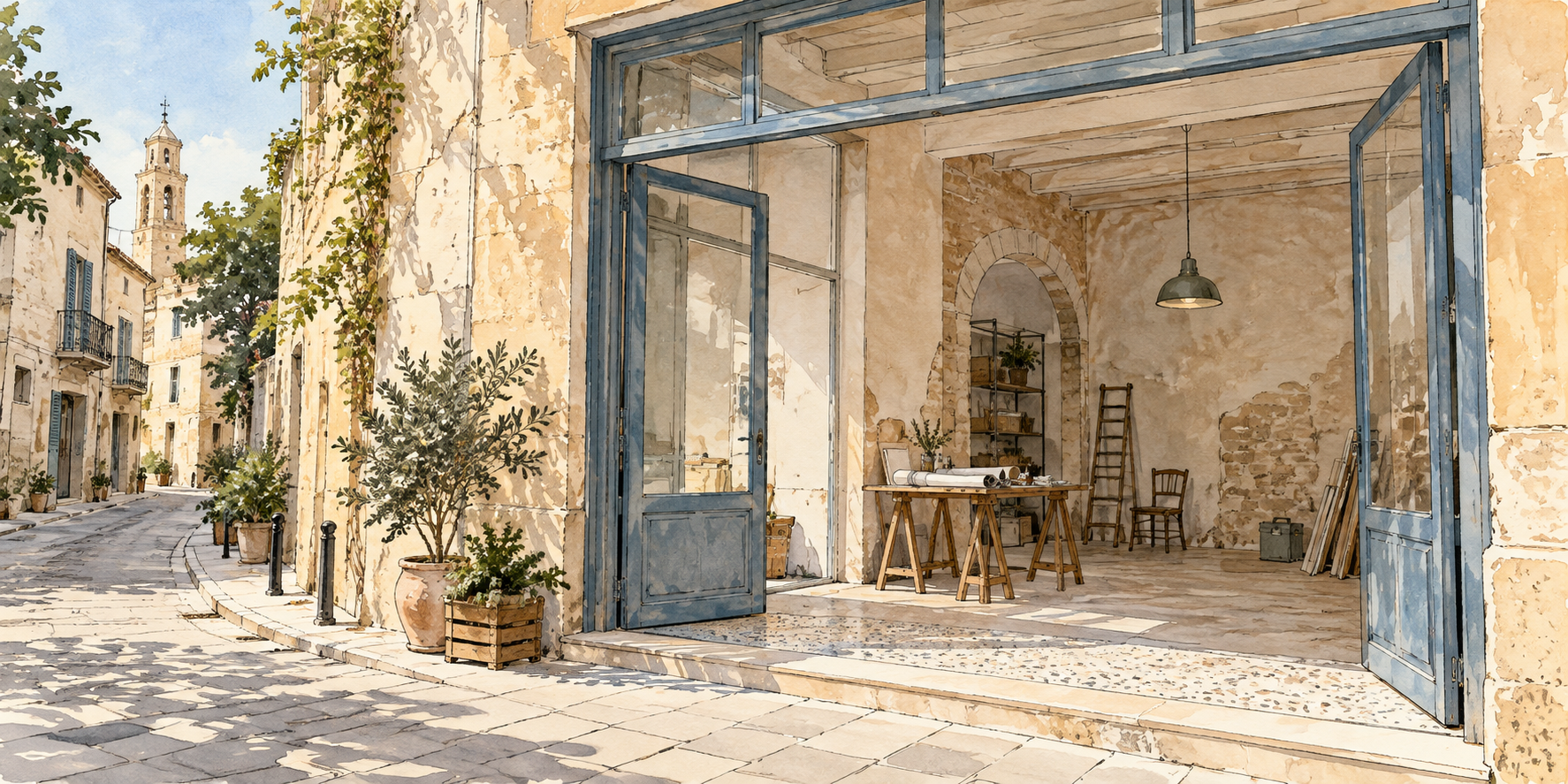
Opening a Business in Old Nicosia
A practical guide for opening a shop, studio, workshop, café or other independent business in Nicosia’s Walled City.
Last reviewed: September 2026.
In this guide
- Start with the business, not the shop
- Make sure the space works for your idea
- Look beyond the monthly rent
- Investigate the Old Nicosia business grant
- Understand the building before designing the fit-out
- Spend first on the things customers don’t photograph
- Check anything specific to your type of business
- Set up the business sensibly
- Choose the neighbourhood as carefully as the premises
- Leave room for the business to evolve
- Quick answers
Old Nicosia offers something increasingly difficult to find in a conventional commercial district: small premises with genuine character, accessible entry costs and meaningful government support for eligible businesses.
The Walled City is full of shops, workshops and unusual spaces sitting between homes, cafés, churches and streets that have accumulated layers for centuries. Some are beautifully restored. Many are not. That is part of both the opportunity and the charm.
Opening in an old building does require a little more thought than taking a ready-made retail unit. The aim of this guide is not to turn you into a planning consultant. It is simply to help you ask the right questions before committing money.
1. Start with the business, not the shop
A beautiful space can seduce you into solving the wrong problem.
Before looking seriously at premises, define what the business actually needs. A small design shop may depend heavily on frontage and passing pedestrians. A ceramicist may care much more about water and a workable floor. A café has different practical needs again. A studio may need little frontage but excellent natural light.
Before viewing premises, think about:
- what will actually happen inside;
- how many people will work there;
- whether customers will visit regularly;
- water, drainage, electricity, ventilation or extraction needs;
- noise and deliveries;
- how much storage you really need.
Then start looking for the space. It is remarkably easy to spend money making the wrong building accommodate the right business.
2. Make sure the space works for your idea
An empty shop does not automatically suit every activity. Before signing a lease or committing to a major fit-out, check that your intended use is workable in the premises.
For a straightforward retail, studio or workshop concept this may be quite simple. Food, hospitality and some specialist activities can require additional approvals or technical work.
The practical approach is uncomplicated: if your project involves substantial alterations, a change of use or a specialist activity, speak to the relevant professional or authority early rather than after the work has been done.
3. Look beyond the monthly rent
Cheap rent is useful. Cheap rent on a space requiring €40,000 of work is rather less cheap.
Compare the total cost of opening, not simply the monthly rent. Depending on the premises, that might include the deposit, electrical and plumbing work, air-conditioning, lighting, flooring, signage, furniture, equipment and professional fees.
Old buildings can also reveal surprises. That is not an argument against them; it is an argument for keeping a contingency.
Sometimes an imperfect old shop that already has most of what you need is considerably better value than the prettier one requiring extensive intervention.
4. Investigate the Old Nicosia business grant
This is one of the most interesting advantages of establishing an eligible business inside the Walled City.
The Cyprus Government’s Grant Scheme for Strengthening and Promoting Entrepreneurship in the Walled City of Nicosia can provide:
Eligible expenditure can include construction and electromechanical work, professional studies and part of the equipment required by the business. Both owners and tenants may potentially qualify, subject to the scheme’s conditions.
That is significant enough to change the economics of opening a business. At a 60% contribution, reaching the €80,000 maximum would correspond to approximately €133,333 of eligible expenditure. This is only an illustration: expenditure must qualify and the application must be approved.
The important point is simpler: if the cost of opening in Old Nicosia initially looks too high, it may be worth doing the numbers again after investigating the grant.
Before committing expenditure on the assumption that it will be funded, check the current official Scheme Guide.
5. Understand the building before designing the fit-out
One temptation with an old shop is to begin by imagining what it could become. Do that — but first understand what is already there.
Look at the electrics, water, drainage, toilet arrangements, ventilation and any signs of damp. Understand what previous alterations have been made. Then design.
Old Nicosia’s buildings often already possess the thing contemporary retail designers spend considerable sums trying to manufacture: character.
An old terrazzo threshold, battered plaster, timber floor or imperfect wall may be worth keeping. Not every old surface is sacred, but neither does every shop need to be stripped back and made new.
6. Spend first on the things customers don’t photograph
There is no shortage of seductive ways to spend a fit-out budget. Pendant lights are more enjoyable to buy than drainage. Unfortunately, drainage has opinions.
Deal with the fundamentals first: structure where relevant, water ingress and damp, electrics, plumbing, drainage, ventilation and cooling.
Once those are sound, the decorative layer can often be surprisingly restrained. In an old building, a careful intervention can be much more convincing than an expensive attempt to make everything pristine.
7. Check anything specific to your type of business
A design studio, bookshop, café, restaurant and food-production workshop do not necessarily have the same requirements.
Rather than trying to learn every possible regulation before you have even found a space, identify the requirements that apply to your particular activity. The Cyprus Government’s Business in Cyprus portal is a useful starting point, and an architect, accountant or other relevant professional can deal with the details when needed.
The useful question is not simply “Can I rent this shop?” but “Does this shop work for the business I want to run?”
8. Set up the business sensibly
The premises are only one part of opening. Depending on how you intend to operate, you may need to deal with business registration, tax, VAT, social insurance and employees.
You do not need to become an expert in all of this before viewing a shop. Once the idea is becoming real, a good accountant can tell you what actually applies to you — usually rather faster than several evenings of creative Googling.
9. Choose the neighbourhood as carefully as the premises
Old Nicosia is not one uniform commercial district. A shop’s relationship with its street matters.
Walk the area at different times and on different days. Watch where people actually walk rather than where you imagine they ought to walk. Look at neighbouring businesses, parking and deliveries, nearby residents and workplaces, universities and student accommodation, visibility and activity after dark.
Also consider what might complement your business. Five independent businesses giving people five reasons to visit the same small area can be more powerful than five isolated shops each attempting to generate its own audience.
That principle is particularly relevant on streets that are still emerging rather than already commanding prime commercial rents.
10. Leave room for the business to evolve
A new independent business will change after opening. Customers will use the space differently from how you imagined. Products you thought were secondary may become important. A workshop may begin hosting classes. A retailer may discover that online sales support the physical shop rather than compete with it.
A good first fit-out should allow the business to evolve without requiring another renovation six months later.
Quick answers
Is there a government grant for opening a business in Old Nicosia?
Yes. The currently published Cyprus Government scheme for entrepreneurship in the Walled City can provide 60% of eligible expenditure, up to €80,000 per project, subject to eligibility and approval.
Can a tenant apply?
Potentially, yes. The published scheme includes qualifying businesses operating as tenants as well as owners, subject to the scheme’s conditions.
What can the grant help pay for?
Eligible expenditure can include construction and electromechanical works, professional studies and part of the equipment required for the project.
Do I need to understand every permit before looking for a shop?
No. Start by understanding what your business needs. Once you have a serious premises or fit-out proposal, check the requirements that apply to that particular activity and space.
Where can I find a shop, studio or workshop in Old Nicosia?
Commercial premises are available throughout the Walled City. ΣΥΝ offers a small collection of independent commercial spaces at the corner of Aischylou & Liasidou, Old Nicosia — behind Agios Savvas Church.
Looking for a space in Old Nicosia?
ΣΥΝ is a collection of small independent commercial spaces at the corner of Aischylou & Liasidou in Old Nicosia, behind Agios Savvas Church.
We are particularly interested in independent businesses, makers and creative practices that can add something distinctive to the building and neighbourhood.
Selected incoming businesses may also be considered for additional financial support directly from the owner of ΣΥΝ, independently of any government funding for which they may qualify.
You do not need to arrive with a fifty-page business plan. A good idea is a perfectly reasonable place to begin.
Official reference links
- Cyprus Government — Grant Scheme for Strengthening and Promoting Entrepreneurship in the Walled City of Nicosia
- Business in Cyprus — Starting your business
- Business in Cyprus — Business premises
- Business in Cyprus — Operating permits
This guide provides general information and is not legal, financial, tax, planning or grant advice. Government schemes and requirements can change; check current official guidance before making financial commitments.